Showing posts with label Peace Fleece. Show all posts

Sunday, July 23, 2023

Made In The Shade


I’m always looking for ways to tweak our decor.  Knit afghans and pillow covers are the usual ways to add color and texture to a room, but I’ve also turned my attention to many of the plain (and inexpensive) off-white lampshades on our small table lamps and vintage floor lamps.

Plain white store bought shades are rather boring and add no character to a space.  They also tend to allow the light to be too bright.

Now, we’re not ones to use 75 watt or larger bulbs. Most of our lamps are fitted with 25 or 40 watt bulbs, a few have 60 watt bulbs, but with even the lower wattage bulbs, I prefer the light to be a bit softer.

Years ago, I achieved this softness by wrapping the shade with wool yarn – it may well have been an idea I saw on a Martha Stewart episode, or in her magazine.


Years later I decided that I would improve on this idea by knitting shade covers.  Of course I could sew them, and I may well get to that one day.  I’ve had these 2 Katrin Cargill books a long time, waiting on me to utilize some of the ideas.


Knitters, though, can create anything they wish while comfortably planted on the sofa or in a comfy chair, where sewing always seems to require standing to measure, cut, pin, and iron.  I don’t mind the process so long as I’m sewing en masse!  I tend to not want to deal with the process just to sew one thing.  Hence, knitting.

I knit these lampshade covers years ago, but never got around to finishing the pattern!  I am offering it here for free.


I particularly like that the shade covers can easily pop on and off, as needed, to swap out for another color cover, or just when more light is needed.

My favorite is the pale yellow one, which covers the shade on the floor lamp in my bedroom/office.  It softens the light *just enough*, and complements the yellow of the counterpane afghan on my bed.

The striped shades came next and show how the shaping within the shade can be highlighted with color.

I used heavy worsted/aran wt. wool yarn for all 3 shades, as it is the weight of yarn I always have on hand.  Naturally, one can knit the shades in a lighter or heavier wt. yarn – just do a gauge swatch and apply it to the size of the shade needed, to get your CO stitch count.

About The Design
The shades are knit flat and shaped with short rows. The CO and BO edges are seamed or grafted, then the top and bottom edges are finished with I-cord.

Measure the top and bottom circumferences of the shade you wish to cover, then determine the ratio of increases needed (via short rows).

It is easiest to measure the top and bottom diameters, then use an online calculator to find the circumferences, such as this one.

The next step is to work a garter stitch swatch.  Garter stitch *tends* to have twice the # of rows for the stitch count, or said another way, it tends to have the same # of *ridges* as sts per inch.  (If your swatch fabric appeals to you and the # of ridges is slightly less, as mine is, don’t fret – it is not critical.)

Then multiply your sts per inch by the depth of your desired shade.  

It is best to err on the side of an extra st or two, rather than less sts.  Even though the I-cord trim at the top and bottom adds a smidge of depth, and despite that knitting IS stretchy and malleable, a couple extra sts will help maintain the needed depth if a bit of width-wise stretching is needed to fit your lampshade.

Shade Style: Empire

Sizes and Yarn Amounts
Sample 1: The yellow cover has approx. a 15” top circ. a 28” bottom circ., and is 7.3” deep.  The shade it fits has a 4” diam. at the top and a 10” diam. at the bottom.

It was knit with Kraemer Yarns Naturally Nazareth Aran wt. (184 yds/100 gr.) in Y1323 Sunshine, and took 85 gr. (3 ozs. yarn.  (This yarn is now discontinued, but some colors can still be found in Ravelry stashes.)

Samples 2 and 3: The blue and cream covers were knit with Peace Fleece Worsted in Galooboy Blue and Antarctic White.

Sample 2 (the narrow blue and white striped cover) has approx. a 13” top circ., a 26” bottom circ., is 7.66” deep, and used 93 gr. (3.25 ozs.) yarn.  This cover also fits the specified lamp shade.

Sample 3 (the wider striped cover) has approx. a 16” top circ. a 29” bottom circ., is 8” deep, and used 113 gr. (4 ozs.) yarn.

One less pattern rep would yield approx. the same size cover as the others.

Needles
Straights, circular, or long dpns, size 8 or 9
Shorter dpns in the same size
Tapestry ndl

Gauge
Naturally Nazareth: 18 sts and 16 rows (8 ridges)/4” in garter stitch with US size 8 or 9 ndls or size to give gauge.

Peace Fleece Worsted: 18 sts and 20 rows (10 ridges)/4” in garter stitch with US size 8 or 9 ndls or size to give gauge.

(I either used a smaller ndl for the Peace Fleece covers OR the 2-ply PF knit denser rows than the Naturally Nazareth, which is a 4-ply yarn.)

Note
I am specifying wool, just for safety’s sake, as lightbulbs, at least the old style, give off quite a bit of heat, and wool is much more fire resistant than synthetics or cotton.  I am likely just being extra cautious, as commercial lampshades certainly *aren’t* made of wool, and are often made of some kind of synthetic fabric or plastic.  I also find that wool doesn’t seem to get dusty.

Special technique - Wrap and Turn (w&t)

Directions - Single Color Cover

Long Tail CO 30 sts, which counts as row 1.
Knit 3 rows = 2 ridges.

* Short Row 1: K10, w&t, k10.
Short Row 2: K20 (knitting the wrap with its st), w&t, k20.

Knit 2 rows = 1 ridge, knitting the wrap with its st on the first row.

Short Row 3: K20, w&t, k20.
Short Row 4: K10, w&t, k10.

Knit 8 rows (4 ridges), knitting the wraps with their sts, on the first row.

Rep from * 23x more.

There will be 60 ridges around the top of the cover and 108 ridges around the bottom of the cover (5 ridges at the top for every 9 ridges at the bottom – a 5/9 wedge.)

BO, then seam the CO and BO edges together (or graft the edges together).

Applied I-Cord

Using 2 shorter dpns, CO 3 sts, then slide the sts to the other end of the ndl.
* K2, slip 3rd st, and with same ndl, pick up 1 st along the edge, then ssk the slipped st with the picked up st. Slide the sts to the other end of the ndl.

Rep from * around the edge.  Graft the end of the I-cord to the beg.

Rep for the other edge.

Directions - Two Color, Narrow Stripe Cover

With blue (A), Long Tail CO 30 sts, which counts as row 1.
Knit 1 row = 1 ridge.

* Short Row 1: K10, w&t, k10.
Short Row 2: K20 (knitting the wrap with its st), w&t, k20.

Knit 2 rows = 1 ridge, knitting the wrap with its st on the first row.  Break A.

Short Row 3: With white (B), K20, w&t, k20.
Short Row 4: K10, w&t, k10.

Knit 2 rows = 1 ridge, knitting the wraps with their sts, on the first row. Break B.

Rep A and B wedges 15x more. There will be 64 ridges around the top of the cover and 128 ridges around the bottom of the cover (2 ridges at the top for every 4 ridges at the bottom – a 2/4 wedge.)

BO, then seam the CO and BO edges together (or graft the edges together), then work Applied I-cord.

Directions - Two Color, Wide Stripe Cover

With blue (A), Long Tail CO 33 sts, which counts as row 1.
Knit 1 row = 1 ridge. Don’t break A.

With B, knit 2 rows = 1 ridge. Break B.

With A, knit 2 rows = 1 ridge..

Short Row 1:
K11, w&t, k11.
Short Row 2: K22 (knitting the wrap with its st), w&t, k22.

Knit 2 rows = 1 ridge, knitting the wrap with its st on the first row

Short Row 3: K22, w&t, k22.
Short Row 4: K11, w&t, k11.

Knit 2 rows = 1 ridge, knitting the wraps with their sts, on the first row. Don’t break A.

With B, knit 2 rows = 1 ridge. Don’t break B.
With A, knit 2 rows = 1 ridge.  Break A.

With B, knit 2 rows = 1 ridge.

Short Row 1: K11, w&t, k11.
Short Row 2: K22 (knitting the wrap with its st), w&t, k22.

Knit 2 rows = 1 ridge, knitting the wrap with its st on the first row

Short Row 3: K22, w&t, k22.
Short Row 4: K11, w&t, k11.

Knit 2 rows = 1 ridge, knitting the wraps with their sts, on the first row. Don’t break A.

Alternate the A and B wedges with the all B wedges 7x more.

There will be 80 ridges around the top of the cover and 144 ridges around the bottom of the cover (10 ridges at the top for every 18 ridges at the bottom – a 5/9 wedge.)

BO, then seam the CO and BO edges together (or graft the edges together), then work Applied I-cord.

Happy Knitting!
Dawn

Thursday, August 4, 2022

In Two Shakes of a Lamb's Tail.

(originally posted on WP 11/10/20.)

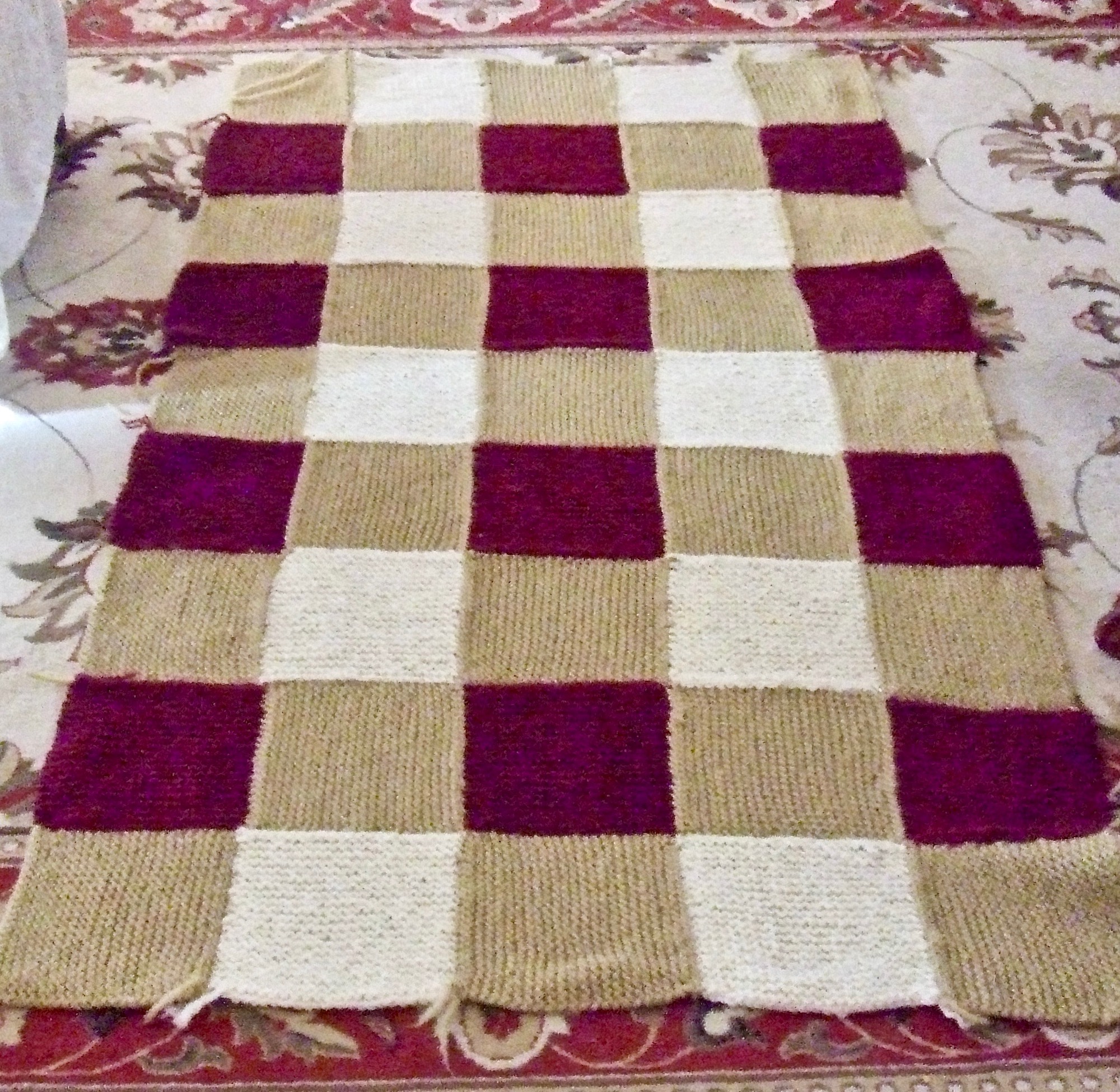
It’s been a busy week since my last post (when is it not!)  As of yesterday morning, I had almost 7 rows and columns sewn together.

By last night, all 9 rows of 5 squares each were all sewn up.


Today, I need to weave in all the WS tails, and begin the edging, likely in the creamy white, as the 17 ozs. of Samantha-Katya Pink Peace Fleece is used up, and there’s only 60 grams left of the Lanaloft Bulky in Wheat from the almost 35 ozs. I began with.  

Not sure why they call this color Samantha-Katya Pink, as it’s a red wine color, but there you have it.

All the Peace Fleece yarn came from deconstructed design samples, and the LLB was a 1/2 price bargain buy from LittleKnits.com.  The creamy white handspun, which filled in for the only 5.75 ozs of PF in Antarctic White I had, was some 2 ply Domestic 56’s top. which I had no other use for, so the afghan cost me very little in outlay – a good thing, as the hubster may or may not like it.  If he doesn’t, I’m sure I can use it.

I made stitch and row adjustments to each square (and hence to the seaming sequence), to accommodate the varying yarn grists.

So far, it is about 39-40”wide x 69-70” long, weighs 4.66 lbs. and is about 17 days in the making, with perhaps 2 days’ work remaining, so will meet my expectation of a 2 to 3 week afghan easily!

Onward,
Dawn


A Dathering of Garters (or a Skyscraper of Squares?)

(Originally posted on WP 11/3/20.)

Only 11 left to knit since I took this photo, this morning.

Was considering a quilt block layout of some kind, but as it's meant for hubby, I think a classic buffalo plaid layout would suit.

Kitchen table only holds 4 rows – there will be 9 rows.


I could have knit them as strips – either lengthwise with 9 blocks per strip, or crosswise with  5 blocks per strip, BUT, I thought the texture would be more interesting if the blocks alternated their garter stitch directions. Had I worked the squares diagonally from corner to
corner, then alternating the blocks could have resembled a faux broken twill, though the constant increasing then decreasing of each square would have tested the limits of evening brain power!

As for the joining, I don't like all the starting and stopping of joining just 2 squares together until each row is done.  That's just too tedious.  What I will be trying is * joining across 2 rows of unattached squares; rep from * down its length, until all squares are attached horizontally.  Then join down each column of squares.  This way, the joining rows will be continuous, with FAR less ends to weave in.

Undecided yet as to which way to join – seam them or crochet slip stitch them together.  I will likely try both and see which looks best and irks me the least!

Then the border.  Again, I may try 3 – a knit up then immediately BO edge, an I-cord edge, and a crochet slip stitch edge.  The I-cord and crochet edges will use more yarn, so the amount of yarn I have remaining will help determine the edging choice.

Onward,
DAwn


The Easy Two Week Afghan (not!)

 (Originally posted on WP 10/25/20.)

I have a variety of lists usually going at the same time - the chore list for that day, the fiber to-do list, the household sewing list, and the household needs-rearranging before it makes me nuts list. This last list I am needing to ignore, as the house, particularly the living room, for some time yet looks more like a hospital room than a living room.

On my fiber to-do list has been the making of a long-enough wool afghan/blanket for hubby.  Originally intended for when he is stretched out in his recliner, although lately, and for some time to come, he will need it for all the resting he needs to do on the loveseat and
then the hospital bed which should be coming at some point, which will be put into the living room.  

Like me, of all the quilts and blankets in the house, he prefers wool.  I'd be lost without my wool afghans!

I had intended on weaving him one, and had cogitated about the pros and cons of either putting a warp for one afghan on the floor loom (bah), or weaving 3 panels on the RH loom (triple bah).  

But, as sometimes can happen, this decision has been made for me.  I have been far too busy during the day spinning yarn, and dealing with current life and household work, to warp either loom. Not to mention that there really isn't room in the dining room/studio to  *both* spin and weave. If I'm spinning, the loom needs to be pushed out of the way.  That poor kitchen towel warp is still on it, since July!, with one towel left to weave, sigh. What I need is something easy to work on in the evenings when I'm resting with my feet up, before bed.

So, I pulled out Barbara Walker's stitch dictionaries.  And noped my way through them.  Stitch patterns either too busy, too small, too modern-looking, or too complicated for a weary brain and body to handle. I briefly considered EZ's garter stitch blanket, but the idea
wasn't tickling me, either.  

I want something classic, traditional, which doesn't involve stranding, cables, or slip stitches. I love stranding color patterns, but not only do my hands naturally want to knit color work quickly (which isn't relaxing!), but more than likely I’d run out of yarn.

I am needing to work with *just* what I have on hand, which is about 18 ozs. of Peace Fleece Worsted in Samantha-Katya Pink, which is a lovely wine color, 7 ozs. Antarctic White (although I can supplement with plenty of handspun creamy white 56’s and long wools), and 38 ozs. Brown Sheep Lanaloft Bulky in Wheat.

These 3 colors just happen to coordinate with our living room area rug. If needed, I have some lt. olive Naturespun Chunky, or doubled Lamb's Pride Worsted I could add in here and there.

So then, garter stitch.  Simple, cushy, no wrong sides.

I love quilt patterns, and remembered I had seen the Flying Geese and Log Cabin patterns knit up, so I checked.  I had a feeling the triangles in Flying Geese

https://www.purlsoho.com/create/2015/04/13/flying-geese-knit-baby-blanket/

would catch me up, causing me to spend too much time ripping out, from not paying attention, so then I considered this classic Log Cabin, but I don't have the right proportions of yarn available. (Scroll down to Cloth #1.)

So, I sketched several layouts of squares – the simplest, least stressful thing one can knit! I knit a few gauge swatches, and am in the process of knitting up 40-45, 8" squares. Well, 7.75" squares, but I'm not gonna fuss over the 1/4", not for an afghan. And unlike my usual designing modus operandi, the final design is not written in stone.  Once there’s enough squares knit, I’ll just lay them out and play with the order, until I like it.

Now, the LLB is a thicker yarn *by weight* than doubled PF worsted, but is a thinner yarn by grist. Don't we knitters just love these odd yarn idiosyncrasies! Not to be deterred by a small difference in gauge, I simply worked a couple more sts and rows in the LLB. We are the masters of our knitting, not the other way around!

Unlike stranded colorwork, I find garter stitch to be slower knitting, which is good for me right now, made slower still by the thickish yarn, ndls, and gauge. It’s the push-past-the-purl-bump bit!  To me, those purl bumps want to be purled into, not knit into, so it has taken several decades for me to have some appreciation for garter stitch – not until I saw this Classic Elite design on the back cover (if I remember right) of a Vogue Knitting issue 9 yrs ago!

I haven’t knit it, but filed away the idea that garter stitch *can* look sophisticated.

The last thing I needed to figure out was how long it would take to knit up the squares and either seam them or crochet slip st them together, then I-cord around the entire thing.  If I knit 3 per evening, it could be done in two weeks.  I *cannot* hear or write the words 'two weeks' without this popping into my head.

It would be a miracle, indeed. Realistically, at 1 to 2 squares each evening, it'll take about 3 weeks. Done by Thanksgiving. OK, I'll need to live with that, as I only have about 1.5 hrs each evening to knit.

These days, don’t we all need something simple to make? Something repetitive which doesn’t tax our energy and resources. Something that allows the mind to relax and wander, to dream of better times to come…

Onward,
DAwn


Switching Gears

(Originally posted on WP 9/16/20.)

Homemaking/housekeeping has always involved multi-tasking, but lately my work also has me going in different directions.  Some days I am at the rug loom (although these kitchen/tea towels, for our use, have been sitting on this loom for weeks, waiting on me to have time for them!)

Other days I am either knitting up design samples, at the computer, working on the patterns and charts, or tackling the long-ish process of uploading designs to various sites. In the evenings I can be found knitting plain/mindless socks, which tends to be a self-adjusting activity, where if I’m really tired, it lets the mind decompress, whilst still being productive.  On other evenings, it allows the mind the freedom to wander and think up new designs or problem-solve, like designing a house that has auto-wash.

And on other days yet, I am weaving samples on the Little Loom, trying to ascertain what, if anything it will do well.

This is where I have been until recently.  

I wish there were two of me, or I at least had Mrs. Weasley’s housekeeping magic spells, then I could have gotten those kitchen towels and these knitting patterns finished already, although I wouldn’t be wasting my magic spells on auto-knitting, rather the dishes, laundry, and cleaning – especially now that this well-lived in house is desperate for a fall cleaning!

So, the Little Loom had me derailed.  I really needed to see what it could do, so I could have a useable warp on both looms, thereby allowing something productive to be accomplished, no matter which room I needed to be in.  

Well, that was the plan, anyway.

I am beginning to surmise that it can only do some things well, and only a few of what I want to make are on this list.  I have only owned sturdy floor looms (except my very first loom, which was upgraded soon after buying it), and like my knitting gauges, I prefer as densely woven a fabric, as can be made without undue stress to the maker, whilst maintaining a pleasing fabric.  

This is one of the best ways to ensure longevity.  I have long said that knitting ball band gauges are a guideline, not to be adhered to, as they can tend to be too loose.  Same goes for their touted yarn weight.  But that’s for another discussion.

For example, a pick and pick weft-faced sample on the floor loom can be beaten to 6.5 picks to the inch easily, using t-shirt yarn and doubled 8/4 warp, sett at 4 working epi, making a firm, well-woven fabric.


The same sett with even slightly thinner t-shirt yarn can only get 5 ppi on the RH loom, and that is with really pressing the weft into place using my forearms on the heddle so to give it a good even beat.  

The ‘even’ part isn’t easy on a RH loom.  If one holds the heddle at the outer edges to beat (as I often see RH weavers do), the middle of the fell can tend to not be beaten to the same level as the edges, so I have been conscientious about holding the heddle with each hand about 1/3 of the way across the fell.

But with these samples needing to be rug-tight, it required even arm pressure along the entire heddle.  Pita is an understatement!  I could show you the bruises I had on my inner forearms to prove this, but I’ll save you.  One would need to use a hand beater, perhaps even the heaviest weighted hand beater to pack each weft shot in to achieve what the floor loom does easily.

And plain weave with the same weft and warp used singly sett at 7.5 epi yields similar ho-hum results.  No photos to show, as I un-wove each one – I only save samples I am pleased with.

The only fabric I have been really happy with thus far is wool.  Peace Fleece doubled in a 5-dent reed, woven with doubled weft, then soaked and very lightly fulled in the dryer makes a totally great afghan/blanket fabric, which I’d like to make for hubby, as my knit wool afghans are a bit too short, for when he’s stretched out in his recliner (though not using the Georgia Rose pink!)


That is, if one wanted to weave narrow panels then seam them, which I am not yet sure I want to do, not when I could weave it full width on the floor loom, in one piece.  The downside to using the floor loom of course, is all the time it takes to warp which involves removing the breast beam and reed, and having enough yarn packages to warp its 2” sections.

Sigh.

I recently wove these pick and pick weft-faced mug mats/coasters on the RH loom, as a gift for one of my brothers.


The RH loom did these well and easily.  Doubled 8/4 warp, in a 5-dent reed, doubled KnitPicks Dishie as weft.

I am surprised to not see Dishie used more often in weaving, as it’s a really lovely, soft cotton yarn, which doesn’t shrink after washing and drying.  I much prefer it for rug hems than 8/4, which tangles if you look it it sideways, which I must be doing a lot.

I have one more cotton sample to put on the RH loom (Dishie at 11 epi), then onto the bulky to super bulky handspun wool samples, but they can wait.  Have already switched gears and am back to working on the last 2 of 3 wintery knitting patterns and their charts before September passes me by!

The first of the 3 is my Midnight Snowfall Tea Cozy.


In case you’re wondering about the odd sett of 11 epi I mentioned – I only have 5 and 7.5 dent reeds for this ASIL (Ashford Sampleit loom) and am not buying another heddle at this point.  

I find DK to worsted yarn at 7.5 in plain weave to make far too sleazy a fabric.  I have sampled the Dishie doubled in a 7.5 dent reed (= 15 total epi), and it works, though it makes a heavy towel.  This might be a good bath towel fabric, but am not sure about a kitchen towel, and a 16” weaving width isn’t going to make a bath towel!

So, I’ll be sampling the Dishie in the 7.5 dent reed, but threading every other slot  doubled, as such. There are 15 slots to 4”:
000000000000000

Threaded *2 ends in first slot, 4 ends in next slot; rep from *:
242424242424242
= 44 ends/4” after sleying into the holes = 11 epi.

Maybe I’ll like the look of alternating double/single warp ends, maybe I won’t, but the sett should keep draw-in and shrinkage to a minimum, will see!

But first, I need to put Dawn into house-washing mode!

Onward,
Dawn