Showing posts with label garter stitch. Show all posts

Tuesday, October 7, 2025

Shaped Elbow Patches


I’ve always knit EZ’s heart for my elbow patches, but I recently decided to go looking for something different, which doesn’t require paying as much attention on every row, and which covers a larger area of the elbow.  The hearts certainly are wide enough, just not deep enough for how I wear out my elbows!

I found Purl Soho’s elbow patches (see Ravelry), but they use short rows at the beg and the end of the patches, when it seems to me that it would make more sense/be more ergonomic to put the short rows across the middle of the patch, where the elbow actually articulates.  

The pattern follows!  I’ll also be adding it to my blog and Ravelry, for those who prefer to save patterns to their library.

Shaped Elbow Patches
Size (very easily adjustable): 3.5” W x 5” L
Each patch weighs approx. 10 gr.

Yarn used for the samples. or other DK wt. yarn.  The natural patches used 3 strands of lace weight merino held together.

(I tend to use baby alpaca or merino to knit patches for my sweaters, esp. the cashmere ones.  As the sweater’s elbows wear out, the softer yarn patches won’t irritate my pointy elbows!)

US size 4 (3.5 mm) ndls (2 dpns are perfect)

Tapestry ndl

Gauge: 6 sts and 6 ridges (12 rows) = 1” in garter stitch

Long Tail CO 13 sts.
Knit 2 rows

Inc Row 1: K1, m1, k11, m1, k1 = 15 sts.
Knit 2 rows.
Inc Row 2:  K1, m1, k13, m1, k1 = 17 sts.
Knit 2 rows.
Inc Row 3:  K1, m1, k15, m1, k1 = 19 sts.
Knit 2 rows.
Inc Row 4:  K1, m1, k17, m1, k1 = 21 sts.
Knit 2 rows.
Inc Row 5:  K1, m1, k19, m1, k1 = 23 sts.
Knit until piece measures 2” from CO edge.

Short Row 1: K up to last 2 sts, W&T.  Rep this row on the WS.
Short Row 2: K up to last 4 sts, W&T.  Rep this row on the WS.
Short Row 3: K up to last 6 sts, W&T.  Rep this row on the WS.
Short Row 4: K up to last 8 sts, W&T.  Rep this row on the WS.

Knit 2 rows.  (In garter st, it isn’t necessary to knit the wraps with their sts – the fabric actually looks better if you don’t!)

Short Row 1: K up to last 8 sts, W&T.  Rep this row on the WS.
Short Row 2: K up to last 6 sts, W&T.  Rep this row on the WS.
Short Row 3: K up to last 4 sts, W&T.  Rep this row on the WS.
Short Row 4: K up to last 2 sts, W&T.  Rep this row on the WS.

Knit until piece measures approx. 1.5” from the center of the short rows.  Fold the piece in half, along the short rows, to measure.  You will know when to stop, when folded, the active sts align with the last full row, before the shaping.

Dec Row 1:  K1, ssk, k17, k2tog, k1 = 21 sts.
Knit 2 rows.
Dec Row 2:  K1, ssk, k15, k2tog, k1 = 19 sts.
Knit 2 rows.
Dec Row 3:  K1, ssk, k13, k2tog, k1 = 17 sts.
Knit 2 rows.
Dec Row 4:  K1, ssk, k11, k2tog, k1 = 15 sts.
Knit 2 rows,
Dec Row 5: K1, ssk, k9, k2tog, k1 = 13 sts.
Knit 2 rows.  BO in knit.  Break yarn, leaving a tail to seam the patch in place.

Happy Knitting!
Dawn

Friday, January 17, 2025

The Unavoidable Long Pause

It’s been on my mind to post, as I know it’s been over a month.  Time flies when you’re dealing with a lot!

I have 4 samples done for the next design series (2 hats, 1 tam, and 1 sweater), with a minimum of 6 more to knit.  I’m at that point in the design process where I need to work on the pattern notes and begin getting it all written up.  

Every designer surely has their own way of approaching the process.  I tend to swatch, make basic notes, make working charts, then begin knitting, adding to the notes as I go.  Before beginning further samples, I usually need to pause, as I like to then get much of the pattern written up, and the charts finalized.  Formatting, editing, and proofing continue for quite awhile, whilst I knit up further samples, until I feel the pattern presents all the necessary info as clearly and as organized as possible.  Then, there are the photos to take and edit, then get the whole shebang uploaded to 4 sites, then do the minimal marketing I do.

And therein lies my current situation.  I’m at that pause phase in the process, where I need to get all the details written up, but I can’t get to it right now.  Hubby’s health has thrown us yet more painful curve balls (the poor guy is falling apart at the seams), that began mid-November.  Two months later, the issues are still unresolved, so it’s been stressful, looking after him, and taking up the slack, doing his chores as well as mine, and now I also have the taxes to prep for the accountant.  He does what little he can, but his pain and unsteadiness is very limiting.

Like many, if not most, women I have a lot of responsibilities, leaving not as much calm creative time as I would definitely prefer, esp. at my age!  Although I’ll be 66 in a few months, I don’t think of myself as old and ready to retire to a rocking chair!  I take very good care of this body, as it’s the only one there is!, but this, too, takes time and mindful effort, from waking to bedtime.

All this notwithstanding, I still need to knit, especially in the evening, after dinner and my shower, whilst I de-stress.  And right now, the simpler the better.  So, I pulled out a simple garter stitch shawl with built-in I-cord that I began months ago, then tucked into a drawer whilst I knit on design samples.  

I’ve pulled out 4 stitch dictionaries to find the right edging, but the person I will be giving it to loved the bobble and sawtooth edging on the adaptation I knit of Susan Mills’ ‘Highland Fling’, so I may use it again on this shawl.

Unlike most scarves I’ve seen that begin at one skinny end, which then increases to a wider middle, then decreases down to the other skinny end, this one begins at the center bottom.  If one increases just one st at the beg of each row, it makes a deeper, less wide shawl, unless, of course, one keeps going.  If one increases one st at *both* the beg and end of every row, it creates width more quickly.

I am using 1 strand each of a DK wt. superfine merino with a fingering wt.    100% baby alpaca, on US size 10 (6mm) ndls, so that the garter stitch isn’t too dense.  A bit of drape in a shawl is a good thing!

In case you’d like to knit a similar shawl or scarf, this is how I began, inc’g just at the beg of rows:


Long Tail CO 3 sts, turn.
Row 1: (K1, M1) 2x, k1 = 5 sts, turn.
Row 2: (K1, M1)2x, yfwd, slip the last 3 sts purlwise = 7 sts, turn.
Row 3: K3 I-cord sts, M1, k1, yfwd, slip the last 3 sts purlwise = 8 sts, turn.
Row 4: K3 I-cord sts, M1, k2, yfwd, slip the last 3 sts purlwise = 9 sts, turn.
Row 5: K3 I-cord sts, M1, k3, yfwd, slip the last 3 sts purlwise = 10 sts, turn.

Continue until you have your desired width and depth, then BO in Attached I-cord.

If you have more foresight that I, CO with a long enough tail, so you can graft together the 2 I-cord edges at the tip.  I would do this especially if *not* adding an edging.

I plan on then CO sts for the edging and working a perpendicular join at the end of EOR.  I’ll post pics as I progress with it!

Now to go drizzle the orange icing I made onto the orange cake that I baked  today, using freshly juiced and zested oranges!  Good food at least takes his mind off his issues for a bit.

Onward!
Dawn


Saturday, October 12, 2024

The Finish Line

I have been diligently trying to create and release 12 new designs this year, and hopefully, in every year to come, in an effort to make up for far too many years when I couldn’t work on many new designs.

The 2 designs below are #’s 9 and 10 for this year, and as it’s October, it seems I am on track for this year!  At least until the holiday season and hubby’s new batch of upcoming surgeries derails me a bit, as well as the weaving I’d like to get back to, if only for a short time.  

And lest I forget, I still have outdoor garden work to finish, as well as cleaning the rest of the outdoor windows I began a week or so ago!

As I *am* only one person, some things have long ago fallen by the wayside, like the bi-weekly bread baking, or continuing with the bagel-making experiments, or even getting to finish this year’s spring cleaning!

12 patterns may not sound like a lot, but patterns do take a long time.  There’s knitting the samples, making the charts, writing, editing, and proofing the text, taking and adjusting oodles of photos, to get the best ones, then tweaking the layout, so everything logically fits into just as much space as it needs, and no more.  I tend to spend as much time writing the patterns as I do knitting the samples!

Some knitters may wonder if I use test knitters or tech editors.  Short answer: I do not.

Not only have I been designing and publishing my work for over 30 years, but my experience with designing for print publications for many years, as well as being a juried member of the AKD (Association of Knitwear Designers), previously known as PKDG (Professional Knitwear Designers Guild) helped hone these skills.

LOL, now I wouldn't mind having an assistant to take some of the load off, leaving me more time to design.  If said person was also good at creating social media posts and newsletters, all the better!  Like many creatives, I’m not very good at promoting myself.  

Although, to this end, I spent some time recently reinstalling the IOS into the older iPad.  It’s amazing how clogged up that thing got over the years.  Even after deleting everything that the iPad allows one to delete, its entire memory was still full.  

As we no longer depend on it for day-to-day productivity, I just re-installed the IOS from within iTunes on my iMac.  Now, it has under 400 MB memory used up for system, leaving me plenty of space for work. Yay!

I am not one to throw away old technology, willy nilly.  It will serve me to take photos, and hopefully, videos, to upload to instagram.  I do not need a cell phone, and hence do not have one, and although I researched how to upload to IG from a desktop, it was too bothersome to do it that way.  

Now I just need to find time to make IG posts, as well as the FB ones I normally do, and the Mailchimp new product emails, after uploading new designs to 4 websites!  But as the world has long gone visual, instead of written (more’s the pity, as I do love words!), I do need to try and fit into customer’s expectations.  We’ll see how it goes!

Now, those 2 new patterns!

Marina


About the Design:
This is an easy-to-knit and wear triangular scarf / mini shawl. I knit the first one many years ago in aran weight cashmere, although without the I-cord edging, and have used it almost every day! It serves as a scarf, and as a head scarf on cold mornings. It is knit from the center bottom outward, with Applied I-cord, and can be knit to any width.

I’ve sampled it in squishy, soft, undyed 100% superfine merino, as well as in frothy Cascade Yarns Kid Seta in a shimmering aquamarine held with Kraemer Yarns Stotts Ranch Limited in navy.  

Dimensions - before blocking
Width, tip to tip: 50”
Depth, at the center bottom: 12 to 12.5”

Finished Dimensions
Width, tip to tip: 52 to 54.5”  
(The aqua/navy fabric blocks a bit larger than the merino.)
Depth, at the center: 12.5 to 12.75”

Materials:

Natural Sample: YarnUndyed non-superwash merino, 182 yds/100 gr: 2 skeins
Sample weighs 159 gr. (5.6 oz.)

Aqua/Navy Sample: Cascade Yarns Kid Seta, 70% mohair, 30% silk, 230 yd / 25 gm: 3 balls #24 aquamarine; and 
Kraemer Yarns Stotts Ranch Limited, 52% Luxurious Diamond Fiber Kid Mohair / 48% Superfine Merino Wool, 610 yd / 100 gr: 1 skein
Sample weighs 109 gr. (3.85 oz.)

24-32” US size 10.5 (6.5 mm) ckn
2 Size 10.5 dpns

Tapestry ndl

Gauge:

Natural Merino Sample: 18 sts sts & 24 rows = 4” (10 cm) in St st, and 14 sts and 28 rows (7 ridges) = 4” in garter stitch with size 10.5 ndls.


Aqua / Navy Sample:
16 sts sts & 20 rows = 4” (10 cm) in St st, and 13 sts and 28 rows (7 ridges) = 4” in garter stitch with size 10.5 ndls.
To save time, take time to check gauge

Substitute Yarn Weight: Worsted to Aran (WPI = 11.5 to 13)

Skill Level: Beginner

Beach Roses Hat & Mittens


About The Design:
I first used this Fair Isle pattern for a cell phone cover, then immediately planned these women’s mittens and hat.  Most of the color changes are easy to work, only the center motif changes colors frequently.

The roomy mittens are worked Norwegian-style with a back of hand pattern, palm pattern, and 3-st stripes running up each side.  

You can knit the hat first, to get familiar with the patterning, as its only shaping is at the crown. I left the hat pompom-less to show off the flowers circling the top, in between the crown shaping stitches.  

This set would make a special gift!
 
Finished Dimensions
Hat Circ: 21.5”, Hat Depth to Top of Crown: 9”
Mitten Circ: 9”, Total Mitten Length: 10”
Cuff Length: 3”, Hand Length: 7”

Materials - Mittens
Lamb’s Pride Worsted, 85% wool / 15% mohair, 190 yd / 4 oz.:

2.64 oz. / 125 yds. #M10 Creme (MC),

.28 oz. / 13 yds. #M04 Charcoal Heather (A),
1.67 oz. / 79 yds. #M166 Plum Smoke (B),

.51 oz. / 24 yds. #M157 Orchid Blush (C),

.31 oz. / 15 yds. #M159 Deep Coral (E),

.08 oz. / 5 yds. #M03 Grey Heather (F), and
Harborside Aran, 100% wool, 162 yd / 100 gr.: .2 oz. / 10 yds. Sandstone (D).
One pair weighs 4.3 oz.

US size 5 (3.75 mm) dpns, set of 5
Tapestry ndl

4 stitch markers

Stitch holder or waste yarn

Materials - Hat

Lamb’s Pride Worsted:

1.87 oz. / 89 yds. #M10 Creme (MC),

.26 oz. / 13 yds. #M04 Charcoal Heather (A),

.46 oz. / 22 yds. #M166 Plum Smoke (B),

1.17 oz. / 56 yds. #M157 Orchid Blush (C),

.2 oz. / 10 yds. #M159 Deep Coral (E),

.11 oz. / 6 yds. #Mo3 Grey Heather (F), and
Harborside Aran: .19 oz. / 9 yds. Sandstone (D).
One hat weighs 3.88 ozs.

US size 7 (4.5 mm) dpns, set of 5
16-24” size 7 ckn

Tapestry ndl

6 stitch markers

Substitute Yarn Weight: heavy worsted

Gauge:
22 sts and 30 rnds = 4” (10 cm) in St st, and 24 and 26 sts = 4” in color patt with size 5 ndls, or size to give gauge.


20 sts and 28 rnds = 4” (10 cm) in St st, and 22 and 25 sts = 4” in color patt with size 7 ndls, or size to give gauge.

Marina is $3.50, Beach Roses is $6, both on Ravelry, Etsy, my site, and Lovecrafts.

Happy Knitting!
Dawn

Sunday, July 23, 2023

Made In The Shade


I’m always looking for ways to tweak our decor.  Knit afghans and pillow covers are the usual ways to add color and texture to a room, but I’ve also turned my attention to many of the plain (and inexpensive) off-white lampshades on our small table lamps and vintage floor lamps.

Plain white store bought shades are rather boring and add no character to a space.  They also tend to allow the light to be too bright.

Now, we’re not ones to use 75 watt or larger bulbs. Most of our lamps are fitted with 25 or 40 watt bulbs, a few have 60 watt bulbs, but with even the lower wattage bulbs, I prefer the light to be a bit softer.

Years ago, I achieved this softness by wrapping the shade with wool yarn – it may well have been an idea I saw on a Martha Stewart episode, or in her magazine.


Years later I decided that I would improve on this idea by knitting shade covers.  Of course I could sew them, and I may well get to that one day.  I’ve had these 2 Katrin Cargill books a long time, waiting on me to utilize some of the ideas.


Knitters, though, can create anything they wish while comfortably planted on the sofa or in a comfy chair, where sewing always seems to require standing to measure, cut, pin, and iron.  I don’t mind the process so long as I’m sewing en masse!  I tend to not want to deal with the process just to sew one thing.  Hence, knitting.

I knit these lampshade covers years ago, but never got around to finishing the pattern!  I am offering it here for free.


I particularly like that the shade covers can easily pop on and off, as needed, to swap out for another color cover, or just when more light is needed.

My favorite is the pale yellow one, which covers the shade on the floor lamp in my bedroom/office.  It softens the light *just enough*, and complements the yellow of the counterpane afghan on my bed.

The striped shades came next and show how the shaping within the shade can be highlighted with color.

I used heavy worsted/aran wt. wool yarn for all 3 shades, as it is the weight of yarn I always have on hand.  Naturally, one can knit the shades in a lighter or heavier wt. yarn – just do a gauge swatch and apply it to the size of the shade needed, to get your CO stitch count.

About The Design
The shades are knit flat and shaped with short rows. The CO and BO edges are seamed or grafted, then the top and bottom edges are finished with I-cord.

Measure the top and bottom circumferences of the shade you wish to cover, then determine the ratio of increases needed (via short rows).

It is easiest to measure the top and bottom diameters, then use an online calculator to find the circumferences, such as this one.

The next step is to work a garter stitch swatch.  Garter stitch *tends* to have twice the # of rows for the stitch count, or said another way, it tends to have the same # of *ridges* as sts per inch.  (If your swatch fabric appeals to you and the # of ridges is slightly less, as mine is, don’t fret – it is not critical.)

Then multiply your sts per inch by the depth of your desired shade.  

It is best to err on the side of an extra st or two, rather than less sts.  Even though the I-cord trim at the top and bottom adds a smidge of depth, and despite that knitting IS stretchy and malleable, a couple extra sts will help maintain the needed depth if a bit of width-wise stretching is needed to fit your lampshade.

Shade Style: Empire

Sizes and Yarn Amounts
Sample 1: The yellow cover has approx. a 15” top circ. a 28” bottom circ., and is 7.3” deep.  The shade it fits has a 4” diam. at the top and a 10” diam. at the bottom.

It was knit with Kraemer Yarns Naturally Nazareth Aran wt. (184 yds/100 gr.) in Y1323 Sunshine, and took 85 gr. (3 ozs. yarn.  (This yarn is now discontinued, but some colors can still be found in Ravelry stashes.)

Samples 2 and 3: The blue and cream covers were knit with Peace Fleece Worsted in Galooboy Blue and Antarctic White.

Sample 2 (the narrow blue and white striped cover) has approx. a 13” top circ., a 26” bottom circ., is 7.66” deep, and used 93 gr. (3.25 ozs.) yarn.  This cover also fits the specified lamp shade.

Sample 3 (the wider striped cover) has approx. a 16” top circ. a 29” bottom circ., is 8” deep, and used 113 gr. (4 ozs.) yarn.

One less pattern rep would yield approx. the same size cover as the others.

Needles
Straights, circular, or long dpns, size 8 or 9
Shorter dpns in the same size
Tapestry ndl

Gauge
Naturally Nazareth: 18 sts and 16 rows (8 ridges)/4” in garter stitch with US size 8 or 9 ndls or size to give gauge.

Peace Fleece Worsted: 18 sts and 20 rows (10 ridges)/4” in garter stitch with US size 8 or 9 ndls or size to give gauge.

(I either used a smaller ndl for the Peace Fleece covers OR the 2-ply PF knit denser rows than the Naturally Nazareth, which is a 4-ply yarn.)

Note
I am specifying wool, just for safety’s sake, as lightbulbs, at least the old style, give off quite a bit of heat, and wool is much more fire resistant than synthetics or cotton.  I am likely just being extra cautious, as commercial lampshades certainly *aren’t* made of wool, and are often made of some kind of synthetic fabric or plastic.  I also find that wool doesn’t seem to get dusty.

Special technique - Wrap and Turn (w&t)

Directions - Single Color Cover

Long Tail CO 30 sts, which counts as row 1.
Knit 3 rows = 2 ridges.

* Short Row 1: K10, w&t, k10.
Short Row 2: K20 (knitting the wrap with its st), w&t, k20.

Knit 2 rows = 1 ridge, knitting the wrap with its st on the first row.

Short Row 3: K20, w&t, k20.
Short Row 4: K10, w&t, k10.

Knit 8 rows (4 ridges), knitting the wraps with their sts, on the first row.

Rep from * 23x more.

There will be 60 ridges around the top of the cover and 108 ridges around the bottom of the cover (5 ridges at the top for every 9 ridges at the bottom – a 5/9 wedge.)

BO, then seam the CO and BO edges together (or graft the edges together).

Applied I-Cord

Using 2 shorter dpns, CO 3 sts, then slide the sts to the other end of the ndl.
* K2, slip 3rd st, and with same ndl, pick up 1 st along the edge, then ssk the slipped st with the picked up st. Slide the sts to the other end of the ndl.

Rep from * around the edge.  Graft the end of the I-cord to the beg.

Rep for the other edge.

Directions - Two Color, Narrow Stripe Cover

With blue (A), Long Tail CO 30 sts, which counts as row 1.
Knit 1 row = 1 ridge.

* Short Row 1: K10, w&t, k10.
Short Row 2: K20 (knitting the wrap with its st), w&t, k20.

Knit 2 rows = 1 ridge, knitting the wrap with its st on the first row.  Break A.

Short Row 3: With white (B), K20, w&t, k20.
Short Row 4: K10, w&t, k10.

Knit 2 rows = 1 ridge, knitting the wraps with their sts, on the first row. Break B.

Rep A and B wedges 15x more. There will be 64 ridges around the top of the cover and 128 ridges around the bottom of the cover (2 ridges at the top for every 4 ridges at the bottom – a 2/4 wedge.)

BO, then seam the CO and BO edges together (or graft the edges together), then work Applied I-cord.

Directions - Two Color, Wide Stripe Cover

With blue (A), Long Tail CO 33 sts, which counts as row 1.
Knit 1 row = 1 ridge. Don’t break A.

With B, knit 2 rows = 1 ridge. Break B.

With A, knit 2 rows = 1 ridge..

Short Row 1:
K11, w&t, k11.
Short Row 2: K22 (knitting the wrap with its st), w&t, k22.

Knit 2 rows = 1 ridge, knitting the wrap with its st on the first row

Short Row 3: K22, w&t, k22.
Short Row 4: K11, w&t, k11.

Knit 2 rows = 1 ridge, knitting the wraps with their sts, on the first row. Don’t break A.

With B, knit 2 rows = 1 ridge. Don’t break B.
With A, knit 2 rows = 1 ridge.  Break A.

With B, knit 2 rows = 1 ridge.

Short Row 1: K11, w&t, k11.
Short Row 2: K22 (knitting the wrap with its st), w&t, k22.

Knit 2 rows = 1 ridge, knitting the wrap with its st on the first row

Short Row 3: K22, w&t, k22.
Short Row 4: K11, w&t, k11.

Knit 2 rows = 1 ridge, knitting the wraps with their sts, on the first row. Don’t break A.

Alternate the A and B wedges with the all B wedges 7x more.

There will be 80 ridges around the top of the cover and 144 ridges around the bottom of the cover (10 ridges at the top for every 18 ridges at the bottom – a 5/9 wedge.)

BO, then seam the CO and BO edges together (or graft the edges together), then work Applied I-cord.

Happy Knitting!
Dawn

Thursday, October 20, 2022

New Patterns and Staying Cool!

 New Patterns!

I haven't posted recently, as I've been busy trying to get the patterns written for this pile of mostly knit design samples I began up to 2 years ago!

About 10 days ago, I published 'Quilt Cloths' - an easy to knit set of quilt block inspired face/bath cloths, worked in KnitPicks Dishie cotton yarn.  Dishie is soft, smoothly spun, and easy on the hands, unlike some cotton yarns I have tried in the past.  It is also reasonably priced.


The newest pattern release is this - 'Cable & Rib Tea Cozy', sampled in Brown Sheep
Lanaloft Worsted and Lamb's Pride Worsted.  Pattern has 2-3 cup and 3-4 cup sizes, and sport a braided I-cord cable embellishment!  


The 2-3 cup size only needs about 38 gr of yarn, and the 3-4 cup size needs about 55 gr of yarn, which makes this project a way to use up those small amounts of stash yarns to knit up some gifts for the tea drinkers in your life!


Both patterns are available on Ravelry, Etsy, and Lovecrafts.

Staying Cool

Fall is definitely here, with its decidedly crisp air, which means the holidays start to take over our brains!  I, for one, wish there were more time between Thanksgiving and Christmas.  And I'm sure I'm not the only one wishing this!  I've never liked feeling rushed, and like it less the older I get.  

Winter is supposed to be that slow-down time, for rest and contemplation, but I find that doesn't happen until February at the earliest, after the yearly taxes are prepped to send to the accountant.  And here, on Cape Cod, winter only really begins in late December and lasts until March.  LOL, that doesn't leave a whole lotta rest and relaxation time!

It used to be that I lived for those two all-too-short winter months when I wasn't swamped with responsibilities, as it was the only time I ever slept well.  I always need it cold to sleep - a cool head but a warm body, facilitated by many layers of cotton bedding topped with wool blankets and afghans.  This means that every spring through autumn, sleep was a struggle, and we all now what happens to our health when we don't get good quality sleep.  It takes me down quickly, within a few days.  

Several years ago, I discovered this - a Coolbot

It's a contraption that is used by florists and others who need to construct an inexpensive walk-in-fridge.  It overrides the temperature sensor in an AC unit, to allow the AC to cool the space to a much lower temperature than AC's do these days, which, without freon, is only about 62 degrees.

They have an online calculator that shows the size of the AC needed to cool a given room size to one's desired temperature.  For my bedroom of about 10' x 12' x 7.5' high ceiling, the calculator recommends a 10K btu AC unit.  This spec put me off for years!  These windows aren't large enough for a 10K unit.

But this past spring I said to hell with it.  We'll get an 8K AC unit and the Coolbot, because anything lower than 62 degrees is better than nothing and watching my health and functioning fly out the window.  Lo and behold, I can cool my bedroom (in this circa 1947 not well insulated house) to 50 degrees.  I could probably get it colder than that if I wanted, but this is a perfect temp for me, until winter finally settles in, when I sleep with the window open and a twin window fan on.  

So, between the cool room temp every night and the several sleep aids I take, once I fall asleep, I'm out for the entire night.  I cannot tell you what a blessing this is!  Ever since chemo 14 yrs ago, sleep has been difficult at best and almost nonexistent at its worst.  No longer do I need to live for just 2 months of every year - I can actually function decently every day of the year.

If you too struggle with sleep and need it cold in order to sleep well, this gadget is
well worth considering.  Granted, it's not inexpensive, but I'm SO happy we bought it.

Onward!
Dawn


Thursday, August 4, 2022

Sheepy Grey Rescued by Beautiful Norwegian Countryside!

 (Originally posted on WP 3/3/22.)

When I’m feeling loquacious (which hasn’t occurred at all this past year), I tend to start many blog posts. Start, not finish. I want to get the gist of them down on (virtual) paper, lest I forget them.

Time passes, though, and life and work move on, so about half of these half-written posts are no longer relevant. The following post though still holds true. To be honest, I don’t remember if I ever posted it to my old blog.

Sheepy Grey Rescued by Beautiful Norwegian Countryside!

Until recently, I had been knitting up my modest stash.  It amazes me that the yarns and colors I wish I had more of, I don't, yet the yarns and colors I do have, make me go, eh.

Like sheep's grey.  That earthy, isn't quite grey, isn't quite brown, can't make up its mind, murky color, which only men seem to tolerate!  I have bucket loads of the stuff. Well, not bucket loads, but, about 1.5 lbs of it, which is a lot, compared to the bits and bobs in the rest of my stash.

I was beginning to go off the Garter Stitch Deep End, aka Garters on the Brain. Washcloths, in various stages of progress, sit, as yet unfinished, as do the rest of the garter stitch lampshade covers, and a rough sketch of a garter stitch design sits with sample yarn, yet to be fleshed out. But, as I was writing that post, hubby was on his way home from the library, with our usual magazine load – Yankee, Consumer Reports, Martha Stewart Living, Real Simple, Country Living, and any VKs he can find.

What he also had in his arms was The Best of Lopi, More Sweaters, Monkeysuits, and Knit One, Knit All.

This last book is one of two EZ books I did not own. I have Knitter's Almanac, Knitting Workshop, Knitting Around (my all-time favorite), and The Opinionated Knitter.

I don't have Knitting Without Tears, although I did borrow it from the library once, but saw no need to purchase it. But, after slowly perusing it, I had to get a copy of ‘Knit One Knit All’ And although I've seen mention of EZ's Add-A-Bootees, I never saw the pattern. 'Til now.

So, did I finish up the all garter stitch work piled onto the back of the love seat, necessitating that I sit gingerly, lest all the yarn balls, with their attached ndls, don't come tumbling down upon me?  Of course not. I immediately pulled out that boring, sheepy grey wool yarn (Cascade Yarns Ecological Wool), made sure the ball had been wound with doubled strands (it had), pulled out a size 8 Addi Turbo and the old-style Bryspun Flexible dpns (love, no, LOVE my Turbos and Bryspuns, but only the old-style Bryspuns, not the newer, concave ones), and CO an Add-a-Bootee, to see if I like the design.

I'm always up for a good slipper sock design, but, have not (yet, anyway) found one I want to knit repeatedly. We will see how this one goes.

As I cogitate about the matter (and I do like to chew on things, until I really understand my own perspective and motivation), I think my long-time aversion to garter stitch is connected to its use in clothing.

I don't mind it used in household linens, like afghans, area rugs, and the lowly washcloth – the stitch seems to make sense in these applications. In clothing, however, it makes the fabric thick, unless knit in very thin yarn. It also makes it bumpy, and uncomfortable.

For thickness, I prefer Fair Isle or stranding – to me, a riot of color and pattern, or fabulous cable texture, should be the trade-off from having to have the extra fabric thickness. I'm not (yet, anyway!) sold on garter stitch's use in clothing, except, hopefully, these bootees.

But, this post is also about design, not just color. We all have colors we are attracted to like honeybees to flowers. My heart stops when I see a particular shade of intense fuchsia. My brain suddenly goes into dreamy mode. Cobalt blue also has this effect, though to a lesser degree. It's something about the red/blue balance in fuchsia, which speaks to me.

Then I look at earthy colors, like that sheep's grey, and it's Thud. No sparks, no dreaminess, no inner sighing. I know the sheep can't help the color wool they make. And I love sheep. One can hardly be a knitter and not at least appreciate sheep, if not love them, but the earthiness does not inspire design.

Or does it?

I love many things. One thing I love, and have yet to get to do, in my nearly 63 and counting years, is travel. It's one reason I love to read EZ's Knitting Around. I could (and do) read of EZ's magical early years, over and over. All that travel, all those wonderful experiences in places far afield from where she grew up. Some knitters prefer her Knitter's Almanac, but, I'm already that older women, living a hidden-away life, so I don't harken for more of the same – I yearn for Adventure, to, finally, get out of the house!

We can then want to surround ourselves with what we don't have, so I love to watch travel shows – Rick Steves, Rudy Maxa, The Visions series on Amazon, especially Visions of Austria, and to some extent, Debra Rixon's shows.

I cannot watch these shows, though, without seeing design, everywhere.

As Rick Steves' videographer pans across the Western Norwegian countryside, what do I see? Farmhouses in that sheepy grey color, with barn red or white trim - Ooh! Look how well they go together, I think to myself, and store the idea away.

As we’ve owned this cedar-shingled cape-style house on Cape Cod for the past 11 years, I'm well familiar with sheepy grey (it’s everywhere on the Cape), though I'm usually inside, looking out from it, and yes, more white or brick red would punch it up. Same for that ochre yellow house with white trim.  Ocher yellow - definitely not my fav color, yet, used on these Norwegian homes, it suits its place – terroir.

His quick shot of the Bergen harbor (at 17:38 mins. in the above video), shows repeated elements and colors, from the buildings and their roofs below, just screaming to be another design.

Here's another. And another, even better.

Can anyone look at Nyhavn Harbor, in Copenhagen, and not see great colors which work well together? More design.

I actually want to pause at all the great shots, and take photos, to store away as design inspirations!

May sheep (even sheep’s grey fleeced-sheep!) safely graze.
Onward,
Dawn


Back to Basics

 (Originally posted on WP 10/16/21.)

Back to Basics

We all come to appreciate certain things, in our own, sweet, sometimes slow, time!  Which brings me to – I've never been enamored of garter stitch. There, I've said it.

When I began to knit, circularly, that is, after reading a couple chapters of Elizabeth Zimmermann’s ‘Knitting Workshop’, I dove head-first into Fair Isle, stranding, cables, and lace.  Of course, I noticed that EZ used garter stitch, and quite often, but, it just seemed to lack sophistication and knitterly skill.  When I want to do something, I always do it big.  I don't take baby steps, I fearlessly dive in head first.  So, I never knit anything in garter stitch.

Maybe it's age…although blaming things on ‘age’ irks me, as it sounds like an excuse.
What it really is is a too-busy Life for my energy resources – too much to think about and take care of every day, so that when I go to knit, I don’t want (and my brain doesn’t need) anything strenuous, complicated, or fast-paced.

The stage is finally set – a confluence of variables, where, suddenly, my hands are enjoying this simple stitch.  They never did before, though.  I used to wonder how knitters could find garter stitch to be easy.  Yes, it's just knit, knit, knit, but, those purl bumps don't *want* to be knit into.  Ya gotta push past the bump to knit each stitch.  Eh.  

To me, these bumps always want to be purled into, which was, and still is, fine with me.  I have no qualms about purling, even in Fair Isle or stranded color work.  I love stranded knitting.

I do tend to knit, not quite *all* the time, as EZ did, but until the recent health snafu, on most late afternoons into evenings, with just short detours to eat, shower, get all the evening pills and paraphernalia, and tend to hubby’s meal and coffee needs, so I can plop my backside back down, and not have to jump up for anything, until bedtime.

And what do I usually knit?  Socks.  Piles and piles of socks.


Been knitting socks since the beginning of my knitting life, as my feet have always been cold.  I used to buy men's wool hunting socks.  Naturally, they were too large for my feet, but there wasn't (and likely still isn't) anyone making thick wool socks for women's feet.  

Now, why is that?

Don't they know that women can tend to be cold? (Well, at least until menopause!)  Aren't we the ones always inching up the thermostat, hoping the husband doesn't notice?  And, of course he does, making a big fuss, gagging and choking on the heat, as if he was about the melt, whilst making a beeline for the thermostat, muttering to himself, just loudly enough for the wife to hear: "Now who put the heat up?"  When he knows darn well, who put it
up.

But, all of a sudden, as I finished up another pair of socks, to be hand washed and added to the bulging sock drawer, I suddenly dreaded casting on another pair of socks.

Aaack!  What's up with that?  I've never NOT wanted to knit socks, not in 3 decades. Now, I had been knitting up stash.  And my stash, as a designer, never mind as a knitter, has been quite humble, as discretionary income hasn't been a burden for most of those 3 decades.  But, I've been in a clearing-out-the-house frame of mind for a long time.  And, that means yarn, too.  

I also recently purchased the luxury of a new pair of LL Bean sheepskin slippers.

I had a pair many years ago, which lasted 3-4 years with daily wear for 9 months of every year!  Now, that's quality. Then the price went up, and I was back to knitting thick wool socks, instead.  But, sheepskin really can't be beat to warm up feet on cold floors, and didn't I have enough Life Stresses to deal with?  Yup.  So, I deleted from the list having to deal with cold feet!  And they have outdoor soles, so I can get the mail and sweep the leaves off the deck without needing to change shoes.

But, back to knitting and garter stitch. So, with not wanting to knit socks, but needing something to work on every evening (as I cannot just be a couch potato, like men seem so capable of!), I turned to the household – what does it need?  

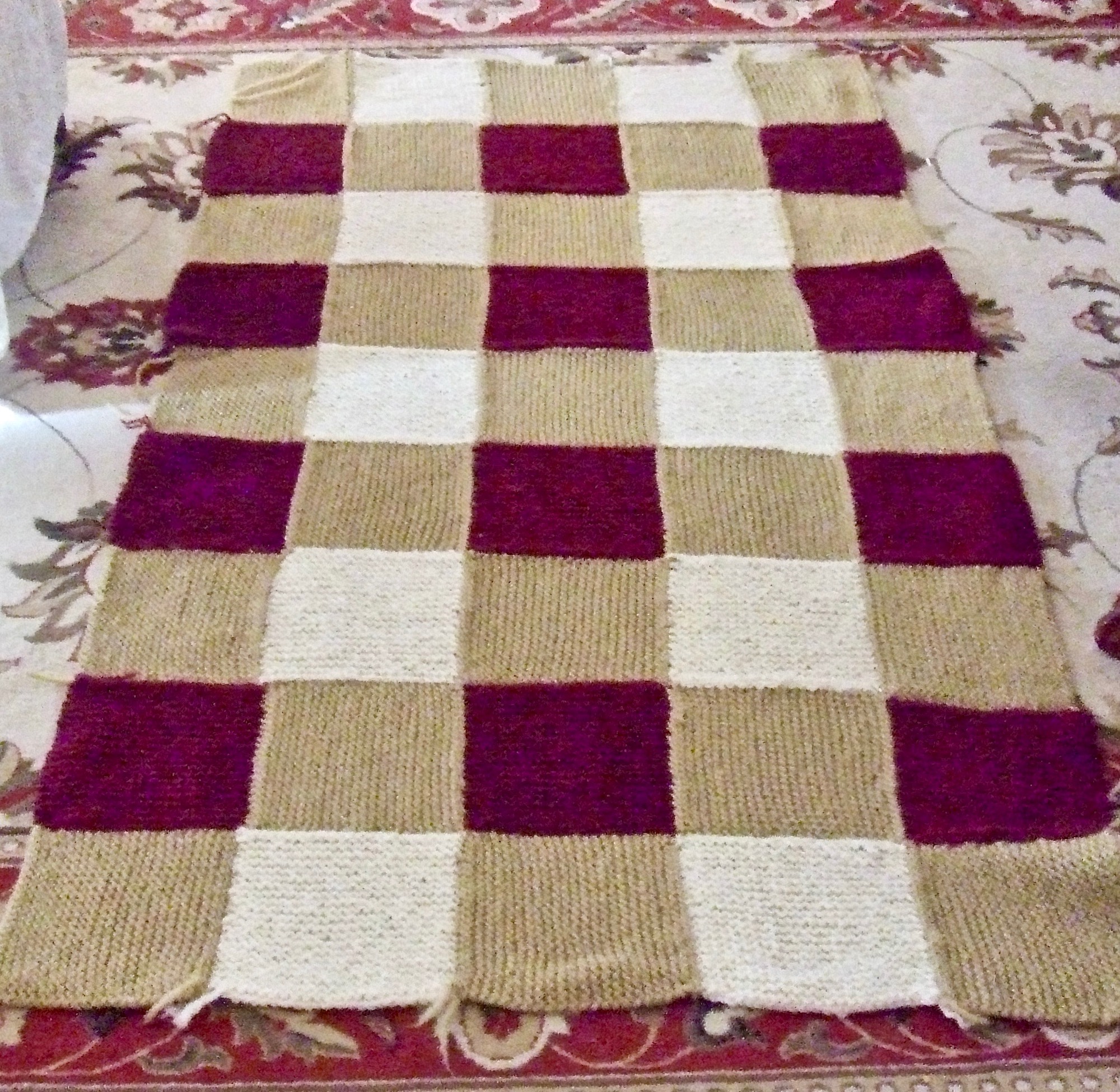
I have a pile of things I need to sew up on the machine, but that’s day work. But hubby had been needing a new afghan – longer than the ones I’ve knit. So began the 3 week journey of knitting bulky knit garter stitch squares for this afghan, now seamed and I-corded, but it hasn’t yet had it’s bath, I mean, wet blocking. 


I don’t consider anything I knit or weave as finished until it’s had a bath, been hung or laid flat to dry, then pressed, if needed, as wovens tend to need.  So, please forgive any lumpiness you see – stitches becomes much more cohesive and smooth with a bath. Washing large afghans and blankets is so much easier once it’s warm enough outside, so they can be draped over the line.

The afghan has been done for months now, but the need for more easy knits still reigned.  So, what else does the house need?  Hmm, could use some pretty, and decorative (though not just decorative!) face/bath cloths.  

We may decide to rent the entire house out next summer (as this IS Cape Cod), or, perhaps list it for sale before then, and although I am working towards unifying color and design through the entire house to exude a coastal farmhouse style (a large enough project!), I also want the house to exude personality and not look sterile, like a stager has been here.  

This means showcasing hand-crafted textiles throughout – from the bathroom to the kitchen and bedrooms.  Bits of color, pattern, and texture, so, either guests or prospective buyers will remember the house as looking expectedly coastal, but with unique, handmade touches that say it’s a home, not a showroom. I can never imagine myself living in those stripped down to almost nothing houses - it’s as bad as trying to imagine living in an empty house.

When I need design inspiration, or my knitting mojo has temporarily lost its oomph, I often turn to other textiles – needlepoint, sewing, and quilting books, like these 1980’s vintage quilting books, the spine of one long ago split the book into two.  Quilting was one of my first ventures into the making of textiles.


Simple (and some not very simple) geometric quilting patterns translate well into knitting and especially into garter stitch.  There ya go – next knitting pattern decided.

Here are the face/bath cloth samples I’ve knit thus far, though to be honest I think these are more than enough for a written pattern!


I worked to present quilt blocks in a knittable way.  Some blocks would require far too many color changes, and hence, ends to weave in afterwards, but if I really like a particular block, I play with it’s size or repeat to achieve a pleasing and easily-workable interpretation.  

I also look at each quilt block or repeat of blocks to consider the best construction method – should it be knit in one direction or from varying directions? Totally seamed later on, or picked up and knit as you go?

You can see from the photos above, that just as in hubby’s buffalo plaid afghan squares, I prefer the textural interest which comes from changing knitting direction on each afghan square and each segment of the garter stitch face/bath cloths.

They make for pleasant, easy knitting, even in the 100% cotton yarn I used. I was never fond of knitting cotton, but this cotton (Knitpicks Dishie) is really lovely, soft, and smooth.  The blocks could also easily be knit in varying weights of wool yarns, to become an afghan or blanket, which I may get to one day. Although, on the To-Make list, for many years now, has also been the knitting of a queen-sized wool counterpane – LOL, once I find enough patience to want to knit the same square over and over!

As I am currently detoured into spinning and knitting up winter/holiday items for sale, the pattern for these face/bath cloths may take a few months yet. And, who knows, I may find yet more quilt blocks I really want to knit up!

Onward!


In Two Shakes of a Lamb's Tail.

(originally posted on WP 11/10/20.)

It’s been a busy week since my last post (when is it not!)  As of yesterday morning, I had almost 7 rows and columns sewn together.

By last night, all 9 rows of 5 squares each were all sewn up.


Today, I need to weave in all the WS tails, and begin the edging, likely in the creamy white, as the 17 ozs. of Samantha-Katya Pink Peace Fleece is used up, and there’s only 60 grams left of the Lanaloft Bulky in Wheat from the almost 35 ozs. I began with.  

Not sure why they call this color Samantha-Katya Pink, as it’s a red wine color, but there you have it.

All the Peace Fleece yarn came from deconstructed design samples, and the LLB was a 1/2 price bargain buy from LittleKnits.com.  The creamy white handspun, which filled in for the only 5.75 ozs of PF in Antarctic White I had, was some 2 ply Domestic 56’s top. which I had no other use for, so the afghan cost me very little in outlay – a good thing, as the hubster may or may not like it.  If he doesn’t, I’m sure I can use it.

I made stitch and row adjustments to each square (and hence to the seaming sequence), to accommodate the varying yarn grists.

So far, it is about 39-40”wide x 69-70” long, weighs 4.66 lbs. and is about 17 days in the making, with perhaps 2 days’ work remaining, so will meet my expectation of a 2 to 3 week afghan easily!

Onward,
Dawn


A Dathering of Garters (or a Skyscraper of Squares?)

(Originally posted on WP 11/3/20.)

Only 11 left to knit since I took this photo, this morning.

Was considering a quilt block layout of some kind, but as it's meant for hubby, I think a classic buffalo plaid layout would suit.

Kitchen table only holds 4 rows – there will be 9 rows.


I could have knit them as strips – either lengthwise with 9 blocks per strip, or crosswise with  5 blocks per strip, BUT, I thought the texture would be more interesting if the blocks alternated their garter stitch directions. Had I worked the squares diagonally from corner to
corner, then alternating the blocks could have resembled a faux broken twill, though the constant increasing then decreasing of each square would have tested the limits of evening brain power!

As for the joining, I don't like all the starting and stopping of joining just 2 squares together until each row is done.  That's just too tedious.  What I will be trying is * joining across 2 rows of unattached squares; rep from * down its length, until all squares are attached horizontally.  Then join down each column of squares.  This way, the joining rows will be continuous, with FAR less ends to weave in.

Undecided yet as to which way to join – seam them or crochet slip stitch them together.  I will likely try both and see which looks best and irks me the least!

Then the border.  Again, I may try 3 – a knit up then immediately BO edge, an I-cord edge, and a crochet slip stitch edge.  The I-cord and crochet edges will use more yarn, so the amount of yarn I have remaining will help determine the edging choice.

Onward,
DAwn


The Easy Two Week Afghan (not!)

 (Originally posted on WP 10/25/20.)

I have a variety of lists usually going at the same time - the chore list for that day, the fiber to-do list, the household sewing list, and the household needs-rearranging before it makes me nuts list. This last list I am needing to ignore, as the house, particularly the living room, for some time yet looks more like a hospital room than a living room.

On my fiber to-do list has been the making of a long-enough wool afghan/blanket for hubby.  Originally intended for when he is stretched out in his recliner, although lately, and for some time to come, he will need it for all the resting he needs to do on the loveseat and
then the hospital bed which should be coming at some point, which will be put into the living room.  

Like me, of all the quilts and blankets in the house, he prefers wool.  I'd be lost without my wool afghans!

I had intended on weaving him one, and had cogitated about the pros and cons of either putting a warp for one afghan on the floor loom (bah), or weaving 3 panels on the RH loom (triple bah).  

But, as sometimes can happen, this decision has been made for me.  I have been far too busy during the day spinning yarn, and dealing with current life and household work, to warp either loom. Not to mention that there really isn't room in the dining room/studio to  *both* spin and weave. If I'm spinning, the loom needs to be pushed out of the way.  That poor kitchen towel warp is still on it, since July!, with one towel left to weave, sigh. What I need is something easy to work on in the evenings when I'm resting with my feet up, before bed.

So, I pulled out Barbara Walker's stitch dictionaries.  And noped my way through them.  Stitch patterns either too busy, too small, too modern-looking, or too complicated for a weary brain and body to handle. I briefly considered EZ's garter stitch blanket, but the idea
wasn't tickling me, either.  

I want something classic, traditional, which doesn't involve stranding, cables, or slip stitches. I love stranding color patterns, but not only do my hands naturally want to knit color work quickly (which isn't relaxing!), but more than likely I’d run out of yarn.

I am needing to work with *just* what I have on hand, which is about 18 ozs. of Peace Fleece Worsted in Samantha-Katya Pink, which is a lovely wine color, 7 ozs. Antarctic White (although I can supplement with plenty of handspun creamy white 56’s and long wools), and 38 ozs. Brown Sheep Lanaloft Bulky in Wheat.

These 3 colors just happen to coordinate with our living room area rug. If needed, I have some lt. olive Naturespun Chunky, or doubled Lamb's Pride Worsted I could add in here and there.

So then, garter stitch.  Simple, cushy, no wrong sides.

I love quilt patterns, and remembered I had seen the Flying Geese and Log Cabin patterns knit up, so I checked.  I had a feeling the triangles in Flying Geese

https://www.purlsoho.com/create/2015/04/13/flying-geese-knit-baby-blanket/

would catch me up, causing me to spend too much time ripping out, from not paying attention, so then I considered this classic Log Cabin, but I don't have the right proportions of yarn available. (Scroll down to Cloth #1.)

So, I sketched several layouts of squares – the simplest, least stressful thing one can knit! I knit a few gauge swatches, and am in the process of knitting up 40-45, 8" squares. Well, 7.75" squares, but I'm not gonna fuss over the 1/4", not for an afghan. And unlike my usual designing modus operandi, the final design is not written in stone.  Once there’s enough squares knit, I’ll just lay them out and play with the order, until I like it.

Now, the LLB is a thicker yarn *by weight* than doubled PF worsted, but is a thinner yarn by grist. Don't we knitters just love these odd yarn idiosyncrasies! Not to be deterred by a small difference in gauge, I simply worked a couple more sts and rows in the LLB. We are the masters of our knitting, not the other way around!

Unlike stranded colorwork, I find garter stitch to be slower knitting, which is good for me right now, made slower still by the thickish yarn, ndls, and gauge. It’s the push-past-the-purl-bump bit!  To me, those purl bumps want to be purled into, not knit into, so it has taken several decades for me to have some appreciation for garter stitch – not until I saw this Classic Elite design on the back cover (if I remember right) of a Vogue Knitting issue 9 yrs ago!

I haven’t knit it, but filed away the idea that garter stitch *can* look sophisticated.

The last thing I needed to figure out was how long it would take to knit up the squares and either seam them or crochet slip st them together, then I-cord around the entire thing.  If I knit 3 per evening, it could be done in two weeks.  I *cannot* hear or write the words 'two weeks' without this popping into my head.

It would be a miracle, indeed. Realistically, at 1 to 2 squares each evening, it'll take about 3 weeks. Done by Thanksgiving. OK, I'll need to live with that, as I only have about 1.5 hrs each evening to knit.

These days, don’t we all need something simple to make? Something repetitive which doesn’t tax our energy and resources. Something that allows the mind to relax and wander, to dream of better times to come…

Onward,
DAwn